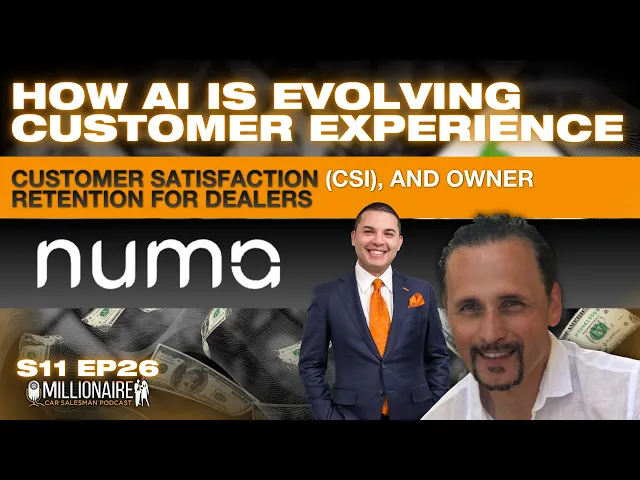

Numa CEO Tasso Roumeliotis on the Millionaire Car Salesman Podcast
AI in Dealerships
Jake Muller
Numa CEO and co-founder Tasso Roumeliotis joined Sean V. Bradley on the Millionaire Car Salesman Podcast for a 50-minute deep dive into why the traditional CSI system is structurally broken, what real-time customer intelligence looks like in practice, and why the economics of heat case recovery make retention the single most important number in the dealership. The conversation pulls from 50 million customer interaction data points across 1,500 dealerships, introduces specific CSI variance drivers that most GMs have never seen quantified, and lays out exactly how Numa's LiveCSI works, from the dashboard a manager opens every morning to the generative AI that produces a heat case extinguishment strategy for each at-risk customer. This is one of the most data-dense conversations Tasso has done publicly.
Introduction
Sean V. Bradley has spent almost 28 years in the automotive industry and built one of the most listened-to sales training communities in the business. The Millionaire Car Salesman Podcast is built around the premise that selling more cars is a craft, not an accident, and that the data almost always tells you exactly what to fix.
When he brought Tasso Roumeliotis on, he made a point of framing it as a departure from his usual sales-first content.
"Today, I really want to focus on something that's just as important, if not more important. It's going to be the customer experience, making sure that we really focus in our industry about CSI, survey results, reporting analytics, and things that help the OEMs and the dealers get a clear picture of where they actually stand."
The reason he framed it that way is the NADA math he opened with: a prior customer carries a 65% closing ratio and higher gross profit. A service customer is seven times as likely to purchase a vehicle from the dealership where they service their car. And 65% of overall profits, plus 100% of all dealership expenses, need to be absorbed through service or fixed operations.
"You don't want to just be that guy at the gym that's working out their arms. And they've got like these really diesel arms. So they got chicken legs and somebody blows and you fall over because you're top heavy. You want to have an equal approach, a symmetric approach, a synergistic approach to your success."
What followed was a conversation that covered the history of CSI, the specific failure modes of the current system, the data Numa has built from 50 million customer interactions, and the retention math that changes how you think about every dissatisfied customer in your service drive.
Key Takeaways
The dealership is a retention business first. Tasso said it plainly and Sean made him repeat it: "You are fundamentally in the retention business." The Toyota manufacturer lifetime value figure he cited — $400,000 per lost customer — is the number that makes this real.
Traditional CSI is an autopsy report. Only 2–10% of customers who receive an OEM survey respond. The dealer finds out results 45 days later. The information arrives after the damage is done and nothing can be fixed.
What you need is a heart rate monitor, not an autopsy. Tasso's framework: real-time customer intelligence that surfaces what's happening in the shop right now, not what happened six weeks ago.
Numa has analyzed 50 million customer interaction data points across 1,500 dealerships in the last 90 days alone, evaluated every 15 minutes, categorized as positive, neutral, or negative.
A 60% advisor ignore rate causes a 40-point CSI drop, the single biggest driver of CSI decline Numa's data has identified.
Proactive status updates create a 32-point CSI differential. Top-quartile stores that give proactive updates score 94. Bottom-quartile stores that don't score 60. That's a 32-point gap from one behavior.
10 times more negative sentiment exists at 5 PM than at 8 AM. Staffing decisions need to account for this. The afternoon is what Tasso calls "the time of broken promises."
Dealerships with 10% more angry customers than average have 50% less service department profit. The heat case problem is an economics problem before it's a satisfaction problem.
Resolve a heat case and 70% of those customers return within six months. Let it go unresolved and the retention rate falls to 5%. That's a 14x difference.
Dozens of stores have mounted TVs showing a live CSI scoreboard, the most effective adoption strategy Tasso has seen for getting advisors to use and compete on the data.
The CSI gap between OEM brands is smaller than the gap within them. Within Mercedes, for example, some stores score 90 and others score 40. The OEM is not the differentiator. The dealership is.
The Problem with Traditional CSI
Before Tasso explained what Numa does, he explained what's broken about what exists — and he was direct about it.
"The CSI system was set in place for the OEMs to monitor. It started off being, 'Hey, let's make sure that you guys are doing a good job serving the customers of the product that I've designed, that I've built — I as the OEM — making sure that customer is having an equivalent experience for what they think the BMW experience should be or the Jeep experience should be.' It started off that way. And it's a flawed way of doing things in a modern world because it evolved into a compliance tool that the dealers effectively tune it to the test."
The structural problems are two-fold. First, sample size:
"Only two to ten percent of people that get a CSI survey actually respond. So you're talking to over 90% of the people — customers that you served — who don't respond, let alone people that came in the store and didn't have a good experience and are not even available for you to analyze their data."
Second, timing:
"I, as a dealer, don't find out until 45 days later. That survey gets sent off 24 to 72 hours later by the OEM. We have very low sample size, very low response rate. And I now find out 45 days later. Well, that's not cool."
His diagnosis:
"The CSI score is effectively an autopsy report. And what we believe in the modern world is — I need a heart rate monitor. Am I alive or am I dead? Don't tell me after the fact that this customer had a bad experience and that they gave us a one-star review on Google. Can you tell me what was going on so I can try and fix it?"
Sean, who has spent nearly three decades watching this system operate, responded immediately:
"I love that phrase. And I'm going to straight up steal it from you — and at least I'll source you though — about it's an autopsy report instead of it being an EKG. That was a beautiful analogy."
He also named another problem the OEM system created: the "perfect or nothing" mandate.
"When you are putting a gun to someone's head and saying, look, if you don't get perfect CSI, you're going to get penalized here, there — because then it turns into a tool that's not really real."
For a detailed breakdown of what CSI actually measures, how the OEM incentive structure works, and how Numa's approach to real-time CSI management changes outcomes, see From Underwater to Above Average: How One COO Fixed CSI Across 9 Brands.
"You Are Fundamentally in the Retention Business"
This became the most repeated line of the episode, and it originated with Tasso after Sean cited the Toyota manufacturer's $400,000 lifetime value estimate per lost customer.
"That $400,000 Toyota number for retention sounds to me like you're in the retention business because that's the biggest number that exists out there. You are fundamentally in the retention business. In an industry where we're trying to get that sale, sometimes by any means possible, we tend to lose sight of that."
Sean pushed the point further, running through every role in the building.
"And unless you as a dealer, a GM, GSM, Internet director, a sales rep or BDC rep — unless everybody understands that you're not just trying to sell stuff. You are there trying to get people to be happy and stay. Not just them stay, but then getting their friends and their families and their frenemies and their co-workers and their ex-high school friends and all that stuff. They need to understand that this isn't just a suggestion. No, this is vital to your survival."
He made Tasso repeat it one more time.
Sean: "We are in the what business?"
Tasso: "Retention business."
Sean: "My man. That is a simple business that you're in. Your profitability is driven by that."
And then Tasso grounded it in data:
"We see dealerships that have 10% more angry customers than average, and we see them having 50% less profit. There's less upsells that happen because it permeates through the entire organization, this bad customer service. Literally 50% less profit in the service department."
LiveCSI: 50 Million Data Points, Evaluated Every 15 Minutes
The heart of the conversation was Tasso's explanation of how Numa's LiveCSI actually works, not as a product pitch, but as a mechanics walkthrough.
The starting point is data capture across every channel:
"We are trying to capture every customer interaction — customer called and hung up, recording the calls with the dealership employees. Listening to voicemails, watching the texts, watching every piece of information that comes in for that customer experience. And we are evaluating it every 15 minutes. In the last 90 days with about 1,500 dealers, we have about 50 million data points of customer interactions that we're running and assessing — negative, positive, neutral."
The sentiment analysis goes beyond surface-level tone detection:
"The way the system works is it does sentiment analysis on everything that the customer says and analyzes how we're talking to the customer as well. So are we being empathetic? Are we solving the customer's problem?"
When something surfaces, the manager gets a real-time view rather than a monthly report:
"Every dealership has a live CSI dashboard. And they're able to see the customer interactions. And they're able to jump in. Like the manager can jump in and help out or call the customer or do whatever they need to do."
The metaphor Tasso used for what the manager sees:
"Just like you have your voicemail and your email inbox, you have your live CSI inbox. You go to the tool, you pop open live CSI, and it's a snapshot — in fact, like a god board of what's going on in your department. So you can see all the customer interactions and they're all put in buckets. One bucket is the red, the heat cases; there's neutral and there's green."
The generative AI element, which Tasso described as still emerging at the time of recording:
"The system is also going to help you — let you in a little secret here from an AI perspective. It's going to analyze it and it's going to know from other interactions with other customers what we think you should do to win this customer back. So generative AI generates a heat case extinguishment strategy for you. Here's what we think you should do. What we're evolving to is there's a button that you press, like 'do it for me.' And an AI agent does this stuff for you — whether it gives a discount, reaches out to the customer via email, via text, tells you to call, gives you a call script for you to extinguish that."
For a deeper look at how LiveCSI works as a proactive intervention system and how it connects to CSI outcomes, see The 3 Communication Pillars of a High CSI Dealership.
The Data That Should Change How You Staff
Tasso revealed several specific findings from Numa's data that don't appear in conventional CSI reporting. Each of them is a specific, actionable number.
Advisor ignore rate is the single biggest driver of CSI decline.
"If you're running into a 60% ignore rate — so your service advisors are not responding 60% of the time a customer reaches out — your CSI drops 40 points. It's the single biggest driver of CSI drop."
Proactive status updates produce a 32-point CSI differential.
"We have some dealerships that are just aces in terms of giving status updates. So customers don't call in for status updates. Those folks have significantly fewer calls — upwards of 40% of calls to a service department are like, 'What the heck's going on with my car?' We all know that. But if you're proactive about it, your CSI is like 94. If you're not proactive, so the bottom quartile, their CSI score is 60. So 32-point differential just because one group gave a proactive status update and the other didn't. By the way, sometimes a status update is just like, 'Sir, Mr. Bradley, we're working on your car. I'll let you know when I have more details.' That could be okay, too."
Shop time dramatically affects both satisfaction and negative interaction frequency.
"If you're in the shop for one day, your CSI score is 50% higher than somebody who's got the car in the shop for more than seven days. We see that there's 10 times as many negative interactions, the customer irritated, frustrated seven days later than there are before for the same kind of interaction."
Negative sentiment spikes at 5 PM — every day.
"We also analyze it by timing and day of week. Monday is the hardest day. Monday morning is actually fine. But 5 o'clock Monday, especially 5 o'clock Monday — and then 5 o'clock every other day — you have 10 times more negative sentiment at 5 o'clock than you do at 8 a.m. I think we call it 'the afternoon is the time of broken promises.'"
The CSI gap between OEM brands is smaller than the gap within them.
"The variance between CSI and OEMs is not that much. Porsche is number one. I guess we expect that, right? But the variance is only a few points on average. But within an OEM, the differential is the dealership. You have some dealerships that are like at 90 for a brand like Mercedes and other dealerships that are like at 40. So it's all about the dealership, less about the OEM."
Tasso added the fundamental implication:
"What's the difference between a Mercedes dealership and another Mercedes dealership? There's only two differences — the people and the processes and maybe some technology. But what's different is the people and the processes, not the GL 550s or the BMW X5s."
For more on how proactive status updates specifically connect to customer trust and retention, see Seizing the Moment: Getting in Front of Proactive Service Updates.
The Heat Case Math: 70% vs. 5%
The most striking data point in the entire episode was the heat case recovery number, and Tasso presented it with the context that makes it land.
First, what an unresolved heat case costs:
"If you get 10% more heat cases, a heat case is so violating to a dealership's economics. That customer is now going to talk about their terrible experience to 15 different people at a dinner party that they go to. They're going to leave you a one-star review. They're going to drive by your dealership. They're never going to buy from you again."
Then what happens when you resolve it:
"If you're able to fix that heat case, solve it — we see 70% of those customers that were lost customers that absolutely hated you, that were dropping F-bombs on voicemails — 70% of those customers come back into the dealership seven months later."
The comparison number:
"70% of the heat cases that don't get extinguished, it's 5%, Sean. It's more than 10x, like 14 times more likely that you retain that customer if you help them out, if they were in a heat case scenario and you extinguish it for them. Those customers are actually more loyal than just customers you provide good service to."
Tasso's explanation for why the recovery creates deeper loyalty than a smooth experience:
"We've all experienced the like, 'I was having a really bad experience and then you stepped up and you showed me greatness.' And now I love you forever. Now I'm loyal to you."
Sean connected it to his own experience:
"But if you make it right, you've got an ally and a loyal person for life. Because again, especially being a business owner, I can't make sure that everybody says everything perfect at every moment of the day. But I damn sure, as the owner with the name tattooed to my forearm for real, that how I handle the situation — once it's brought to my attention, and if we were in the wrong, I am 100% going to make it right."
The Scoreboard That Creates Adoption Without Resistance
Sean asked the most practical question of the episode: how do you actually get dealership staff to use this tool consistently? Tasso's answer came from watching their smartest dealers figure it out.
"I've never run a dealership, but I know a lot of really smart people that have taken it and done it in an interesting way that I didn't even think was a possibility. One of the first things that we see — some of our smartest dealers, you know what they did? We didn't even know you could do this, but they actually bought televisions and they put it up in their stores. I'm talking about dozens of stores now have TVs up with live CSI and with the ranking, effectively like a scoreboard, of how their service advisors are doing in the service department."
The behavioral effect:
"What happens there is it's very interesting when you create visibility — and if you measure it, it will improve. So if I'm working in a service department and my name is up on the board based off of the performance of something, I'm going to work on that performance. So things start to flow very naturally if you create the visibility. And for some reason, incentives seem to be aligned and people are less begrudgingly resistant to use technology."
Sean immediately recognized the pattern from his own training background:
"When I first started selling cars, we used to have bulletin boards, like the dry wash boards, and we would put pinstripe on them. And we had a leaderboard for sales. And you know, it's funny. It's a self-managing system. Because if a salesperson sees them in a list of 10 to 20 other salespeople, and every morning there's a 10–15 minute sales meeting, and we acknowledge who's on the board — it really sucks when you're always the last person on the board."
The universal principle Tasso extracted:
"Create the visibility."
The Variable Ops Angle
Sean pushed Tasso on whether LiveCSI applies beyond service. Tasso confirmed it does, while being honest about where the acute problem lives:
"Variable ops, obviously, of course, as well. What we see — the reason I bring up service is because 90% of the interaction, 90% of the inbounds, are in the service department. And the problem is very, very acute there. But we believe across the entire dealership."
On the sales side, Numa's approach gives individual salespeople visibility into their own response patterns:
"If I'm a salesperson, we want to give you a tool that allows you to monitor yourself and your speed to get back to customers. And what the right approach is that we have seen other successful sales folks do that yield to better results."
The 78% figure Tasso cited for why speed matters on the sales side:
"Customers buy from whoever picks up the phone and engages with them. I think 78% of customers in the automotive industry buy from the first person that picks up the call when they're reaching out to buy a car."
For managers on the variable side, Numa's tool surfaces the root causes behind performance variance:
"Effectively, to get you the root cause — why is salesperson X outperforming salesperson Y? And if you see the stats that salesperson X is significantly more responsive in reaching out to customers, they have a higher booking rate on test drives. And they do that because when you listen to their phone calls, they are much more customer friendly and empathetic about getting the customer in the door."
Tasso's Executive Recap from the Episode
Sean asked Tasso to close with a direct executive summary. Here it is in Tasso's own words:
"What we believe, and I think most dealerships believe, is that you're in the customer experience business, and the current measurements of customer experience — the CSI as mandated by OEM — is a very dated one. You can't use it to provide great customer experience because, like we said, it's an autopsy report. And what you need is a heart rate monitor. You need to understand what's really going on in your shop real time so you can step in and fix it. You need those kinds of live CSI tools, and you need the tools using AI to help you solve those problems. And if you can rescue a heat case — your retention of that customer six months later is 70%, 70% — versus 5% if you let that customer flail and give you that one-star review. And that's the core metrics that you should be driving to."
Conclusion
This episode of the Millionaire Car Salesman Podcast is one of the most substantive conversations Tasso has done on CSI, retention, and the mechanics of LiveCSI. Sean V. Bradley brought genuine depth to the conversation. He knows the industry from the floor up, and he asked the questions that matter to a GM or Dealer Principal making a real decision, not just listening to product marketing.
The argument that emerges across the full conversation is straightforward: if you are still managing your dealership's customer satisfaction by reading the monthly CSI report, you are looking at your business in a rearview mirror and calling it a dashboard. The customers who left unhappy, who called three times and got no callback, who waited six hours for a status update — they have already decided. The CSI score that arrives 45 days later just confirms what they decided weeks ago.
What LiveCSI changes is the intervention window. When a heat case surfaces in real time, there is still a conversation to have. There is still a reason to call. There is still a path from 5% retention to 70%.
The $400,000 figure is not a marketing number. It is the OEM's own calculation of what walks out the door with a lost customer. Every dissatisfied person who leaves your service drive without being recovered is not an unhappy survey response. They are a compounding financial loss, multiplied by everyone they tell.
Sean said it best at the close:
"You have over 400,000 reasons to care about your customers and your potential customers' perception and their reality when it comes to your dealership."
Frequently Asked Questions
Why does Tasso say traditional CSI is an autopsy report?
Only 2–10% of customers who receive an OEM CSI survey actually respond. The results reach the dealer 45 days after the transaction. By that point, the customer has already decided whether to return, already posted any review they're going to post, and already told the people in their life about the experience. The score tells the dealer what happened. It provides no ability to intervene. An autopsy tells you how someone died. A heart rate monitor tells you when something is going wrong while there's still time to act — which is what LiveCSI is designed to be.
What is a heat case and how does it differ from a standard customer complaint?
A heat case is a customer who is actively dissatisfied, signaling that dissatisfaction through their behavior — calling repeatedly, leaving frustrated voicemails, sending messages with escalating language. They are distinguishable from a standard complaint in that the heat case is identified by the AI in real time, while the customer is still engaged, rather than surfacing in a review or a CSI response after the fact. Tasso's data shows 33 out of every 1,000 customers fall into the visible heat case category at any given time.
What does the data say happens when a heat case is resolved vs. left alone?
Resolved heat cases produce a 70% customer retention rate at six months. Unresolved heat cases produce a 5% retention rate. That's a 14x difference. Resolved heat case customers frequently become more loyal than customers who had a smooth experience, because the recovery creates a stronger emotional connection than a transaction that simply went according to plan.
What is the single biggest driver of CSI decline Numa's data has identified?
Advisor ignore rate. When service advisors are not responding to 60% of customer contacts, CSI drops 40 points. That outperforms every other variable Numa has tracked, including shop time, pricing transparency, and quality of repair. Not responding to customers is more damaging to CSI than almost anything else that can go wrong in the service drive.
Why does the proactive status update create such a large CSI differential?
The 32-point gap between top-quartile and bottom-quartile dealerships, CSI of 94 vs. 60, driven by one behavior tells you that the primary driver of customer dissatisfaction in service is uncertainty, not the repair itself. Customers who don't know what's happening with their vehicle generate their own anxiety, call for status updates, and develop a negative impression of the dealership's competence and care. A proactive update, even a minimal one that simply says "we're working on your car and will update you shortly," removes that uncertainty before it builds. For more, see Why Your CSI Score Is a Lagging Indicator.
How does the LiveCSI scoreboard approach work and why is it effective at driving adoption?
Dozens of Numa-deployed dealerships have mounted TVs in their service departments displaying a live CSI scoreboard ranking every service advisor by their real-time performance metrics. The scoreboard shows the rankings publicly and updates continuously. Tasso's observation is that when staff can see their own ranking and know their manager can see it too, adoption happens naturally — not because of policy enforcement but because the visibility creates its own accountability. As he put it: if you measure it, it will improve.
Watch the full conversation on the Millionaire Car Salesman Podcast with Sean V. Bradley and Numa CEO Tasso Roumeliotis: How AI is Evolving Customer Experience, CSI, and Owner Retention for Dealers


