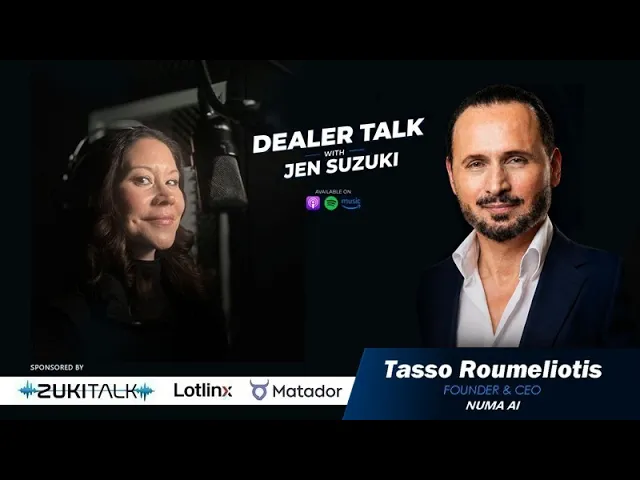

The Next Great Dealership Skill: Leading Through AI Change with Tasso Roumeliotis
AI in Dealerships
Jake Muller
Numa CEO and co-founder Tasso Roumeliotis sat down with Jen Suzuki on Dealer Talk to cover the full arc of Numa's entry into automotive, from an accidental discovery in a Baton Rouge Nissan service department to becoming the #1 fastest-growing dealership software on the 2024 Inc. 5000. The conversation goes well beyond product. Tasso unpacks why most AI resistance in dealerships is a leadership problem rather than a technology one, why CSI today functions as an autopsy report rather than a management tool, and the three skills he believes will define the next generation of dealership operators in an AI-driven industry.
Introduction
Jen Suzuki has spent over two decades in automotive retail. She started selling cars at 18, built a career training service advisors and sales teams, and now hosts Dealer Talk — one of the industry's most direct conversations about what actually works on the floor. When she brings in a guest, she doesn't let them get away with product pitches dressed up as insight.
Tasso Roumeliotis, CEO and co-founder of Numa, held up well.
The episode covers ground that most AI vendor conversations never reach: what it felt like to nearly shut down a dealership's access to a product they weren't even supposed to have. What it means for a GM to build a culture of accountability around AI rather than looking for the easiest thing to blame when it goes wrong. And why Tasso thinks making a DMS decision right now might be one of the riskiest moves a Dealer Principal can make.
Tasso brings an unusual background to automotive. Before Numa, he ran Location Lab, a mobile telco startup that built the first GPS phone location technology in the United States, competing directly against Sam Altman's early company Loopt. The lesson he took from that experience was humility. As he put it:
"I went in to the carriers, and I was like, I'm here to help. I'm going to listen. I'm going to come back and I'm going to build the right product for you. I didn't go in with, I'm from Silicon Valley. I know what I'm doing. And if you don't listen to me, you're an idiot."
That philosophy is what Numa brought into the dealership world, and according to Tasso, it's what made the difference.
The episode runs about 35 minutes and covers more practical leadership ground than most dealership conference keynotes. What follows is a summary of the key themes, the moments worth remembering, and the questions GMs and Dealer Principals are most likely to have after watching.
Key Takeaways
Numa found automotive by accident. The product was originally built for restaurants and salons. A customer referral put it in front of a Nissan service department in Baton Rouge, and dealerships started signing up without Numa even marketing to them. The service advisor's response: "I love your system. Please don't shut it down."
The AI resistance problem starts with leadership, not customers. Tasso's position is that GMs and Dealer Principals need to proactively address what AI means for their team, specifically for long-tenured employees who wonder whether they're about to be replaced. The conversation has to happen before the resistance surfaces, not after.
AI is probabilistic, not deterministic. Unlike a traditional workflow tool that executes predictable steps, AI "has a little bit of a mind of its own." It will do unconventional things. Tasso's guidance is to set realistic expectations from the start: some outcomes will be wrong, and the right response is a root cause conversation, not firing the vendor.
CSI is an autopsy report. The OEM survey arrives after the customer has already had the experience, decided how they felt about it, and often left a review. Tasso's argument is that AI's most underrated capability in dealerships is real-time visibility: a live dashboard of the customer journey, showing call patterns, response times, voicemails, heat signals, and advisor performance as they happen, not weeks later.
Catching heat cases before they become heat cases. Tasso used the phrase "snuff out embers before they become heat cases" to describe what Numa's LiveCSI does. That intervention window is measured in minutes, not days.
The average dealership takes 23 hours to respond to a customer. Tasso cited this figure mid-conversation. His point: building something that responds in 10 minutes, or better, sends the status update before the customer has to ask, represents a meaningful CSI improvement without any other change.
The three skills that will define the next dealership leader are taste, empathy, and futurism. Tasso laid out a framework for what operational leadership looks like in an AI-driven industry, and none of the three skills are technical. They are about judgment, humanity, and strategic thinking.
Tasso would not make a DMS decision right now. His view is that the dealership tech stack is going to look fundamentally different in four to five years, and locking into multi-year infrastructure commitments without visibility into how AI reshapes the underlying workflows is a high-stakes risk.
The Origin Story: Found by a Service Department That Wasn't Supposed to Have the Product
Numa didn't enter automotive with a strategic plan. The product was built for restaurants and salons, and dealerships started showing up without being invited.
Kerry Etienne, a service advisor at a Nissan dealership in Baton Rouge, was the first dealership customer Tasso referenced by name. When Numa's team found out a service department was using the product at 10 to 100 times the volume of the customers it was built for, the reaction was confusion. Etienne's response was simple:
"I love your system. Please don't shut it down."
What followed was the kind of listening that most technology companies don't do. Numa went into the service department, observed how the product was being used, and heard what problems it was solving. What they found was a customer base unlike anything they'd encountered in other verticals.
"We saw a very entrepreneurial, very ROI-driven customer base that would actually, you know the rep, you know, like this is an old industry. It doesn't embrace technology. Actually, absolutely not. This is entrepreneur-driven, ROI-driven. If you can help me solve my problems, I will give you a shot."
Tasso compared it to real estate, where the building owner is typically an asset company with no operational incentive to care about the day-to-day experience.
"The owner of a dealership cares about operations."
That difference, between an owner who manages from a distance and one who is in the operation every day, is what made automotive the right bet. As Tasso put it:
"We saw a customer that we actually fell in love with, their energy and their entrepreneurial spirit. We said, we're going to go here. We're going to go full, full, full go."
AI Resistance: A Leadership Problem Before It's a Technology Problem
One of the most useful threads in the episode is Tasso's framing of AI resistance as a leadership problem first.
His point is that superstar employees with 10 or 15 years of service are asking a version of the same question. Tasso put words to it directly:
"What does this mean for me? I've given you 15 amazing years working my tail off. This company is a pressure cooker and I've been for you here every single day. Are you just going to press a button and I'm gone? That's what they're thinking."
If leadership doesn't proactively address that fear with specificity, the fear turns into resistance, and resistance turns into a wildfire that shuts down adoption before the product has a fair chance. Tasso's management prescription was blunt:
"I care about you and I want you to win. I do. Everybody on my team. And I think the strong dealer operators feel the same way. Yes, they're going to change, and I need you to change in the direction of success and I'm going to be very demanding that you evolve with us. And if you don't evolve, then we have a problem. It's just classic good management."
Jen made the analogy to CRM adoption: a single manager who pushes back and refuses to engage can poison the whole initiative, leaving a bought and paid-for system collecting leads that nobody works. The same dynamic applies to AI. As Tasso noted:
"The difference is the change is much greater because of AI and it's happening much faster. And you have to have that mindset."
The communication behaviors that leadership needs to model — proactive updates, trust-building touchpoints, catching frustration before it surfaces publicly — are the same behaviors that directly move CSI. For a deeper look at how those behaviors connect, see The 3 Communication Pillars of a High-CSI Dealership.
AI Is Probabilistic. Set Expectations Accordingly.
Tasso addressed something that rarely gets said plainly in vendor conversations: AI will sometimes do the wrong thing. Not because the product is broken, but because that's what probabilistic systems do.
"The first thing is that you have to understand about AI is that it's probabilistic, not deterministic. That means that it has a little bit of a mind of its own. It's going to do some unconventional things. You can't guarantee what it's going to say."
The setup expectations problem plays out in a predictable way. Tasso described it:
"Some folks are going to say, look, you don't need a BDC. Just put this AI in there and click on the switch and it's all good. Let it go. And so if you tell me that, well, then that's my expectation. And when that doesn't work out, then I'm like, oh, this AI is not ready for prime time."
His guidance was specific: don't go in expecting AI to replace the BDC from day one. What it's ready for is helping in specific, well-defined situations where it has access to data and can move faster than a human.
"There's things that an AI, especially if you give it access to data, is going to be able to do faster and better than a human can do."
The internal culture a GM needs to build is one of root cause analysis. When something goes wrong, Tasso's question is:
"What went wrong and how what are we going to do to fix it? And do we still want to continue — versus just immediately saying customer is upset, I don't want to take the heat for that. It's really easy to blame the AI and let's play that."
Knowing which questions to ask before signing with any AI vendor is what separates a productive deployment from one that ends in that blame cycle. 5 Questions to Ask Any AI Vendor Before You Sign covers exactly that framework.
The Real-Time CSI Dashboard: AI's Most Underrated Dealership Capability
Tasso described what he called a "God board" — a phrase that got Jen's full attention. The concept is a real-time view of the customer journey across every interaction point.
"You're able to capture all the information, all the voicemails, all the call recording, all the customer experience, and develop a real-time dashboard, a God board, if you will, of what the heck's going on with your customer journey real time. So that is an area where, hey, I can now see who is doing a great job servicing customers and perhaps who needs a lot of help."
The argument is that most GMs are running their service operations in the dark. They find out about a bad customer experience in the CSI report, weeks after the customer has already decided how they feel and where they're going next. Tasso put it plainly:
"CSI today is an autopsy report. And the OEMs agree with us. Yeah, we hear about it after. The customer's already gone. They've already had a bad experience."
That framing is the exact thesis of Why Your CSI Score Is a Lagging Indicator — and What to Track Instead, which covers what to measure in real time to stay ahead of where the OEM survey will land.
"If you can extinguish a heat case before it becomes a heat case, if you can snuff out embers before they become heat cases — that's your use of AI."
Numa's LiveCSI is built around exactly that intervention window. For a full breakdown of how managing these inputs produces measurable CSI outcomes across single and multi-rooftop operations, see From Underwater to Above Average: How One COO Fixed CSI Across 9 Brands. On the 23-hour average response time:
"If you can build something that responds back in 10 minutes, right? Or instantly — or actually like even better, gives them the status update before they have to ask for it — you've done a hundred X improvement on your CSI. So just do that. Like just do that."
The Three Leadership Skills That Will Define the Next Era
Toward the end of the episode, Jen asked what leadership behaviors matter most as the industry goes deeper into AI. Tasso's answer was structured around three things, none of which are technical skills.
Taste. AI can do almost anything. The question is what it should do.
"Having good taste in terms of what we should do, and so instructing the AI to do the right thing. If you look at the great operators — think about Hendrick Automotive, for example, and their core values. Hendrick has amazing taste. I saw the core values everywhere. I'm like, this is somebody that's ingrained into it. So you need that level of taste."
Taste is the judgment capability that no AI can supply from the outside. It has to come from the operator's clear sense of what the experience should feel like.
Empathy. As AI absorbs more of the paperwork, the routine follow-up, and the administrative friction, what remains as the core human contribution is the ability to connect with customers.
"Understanding humanity and empathy, because that is the core competency of your people. It's not going to be about whether they can file the paperwork or get their multiple tasks done, but being able to recruit and build empathy because that is your superpower dealing with customers."
Tasso made the same point in a different frame earlier in the episode:
"You're spending like 75% of your time on paperwork, that means you're not interacting with customers. If I can speed you up, that makes the experience better. There's a huge gap in bringing that exceptional customer experience using humanity. That's what AI is meant to enable."
Futurism. This was Tasso's hardest-hitting point. The tech stack is going to look different in four to five years, and operators who make long-horizon commitments without accounting for that are at risk.
"Your tech stack is going to change. You're not just buying an AI that like voice books appointments. You have to think about does the DMS exist in five years? I mean, like I would not be making a DMS decision right now if I'm a dealer. I would not."
His framing for why:
"Why am I going to do a heart replacement surgery when I might not need a heart to thrive in two years?"
And the stakes if you get it wrong:
"If you make a big DMS decision, and you're multi years locked in, and that's not part of the operating code that drives profitability — your competitors are going to be three to five times more profitable than you. And they're going to kick your butt."
Conclusion
This episode of Dealer Talk is worth watching in full, not for the Numa product coverage but for the operational thinking underneath it. Tasso Roumeliotis spent years in telco, watched a competitor with more funding and less humility fail entirely, and brought that lesson into one of the most operationally complex industries in the country. The lesson translates directly.
AI adoption in dealerships is not primarily a technology problem. It is a leadership problem first, a communication problem second, and a culture problem third. The GMs and Dealer Principals who treat it as a technology problem will keep buying tools that their teams resist, their customers push back on, and their service managers blame when the first imperfect interaction happens. The operators who treat it as a leadership challenge will build the communication culture and the organizational flexibility to actually get value from the technology as it improves.
Tasso's three-skill framework — taste, empathy, futurism — is a useful shorthand for that shift. And his read on dealership culture explains why he made the bet in the first place:
"I love the fact that every day in the dealership matters. You know, like you've got to be an adrenaline junkie to work there. And as an entrepreneur, it's the same kind of thing."
The advisors who thrive will be the ones who connect with customers most effectively while AI handles everything else. The Dealer Principals who thrive will be the ones who stay flexible enough to keep betting as the technology evolves.
Frequently Asked Questions
How did Numa get into the automotive industry?
Numa was originally built for restaurants and salons. A customer referral led to a Nissan service department in Baton Rouge adopting the product without Numa even marketing to dealerships. When the team found out, the service advisor asked them not to shut it down. Numa listened, went into the service department to understand how it was being used, and made the decision to go all in on automotive — a decision that led to 1,300+ dealerships, 1B+ calls handled, and the #1 spot on the 2024 Inc. 5000 for fastest-growing dealership software.
Why do dealership employees resist AI adoption?
The core issue is fear of replacement. Long-tenured employees who have invested years in their roles are quietly asking whether AI means their job disappears. Tasso's argument is that if leadership doesn't address that question directly and proactively — with specificity, not platitudes — fear turns into resistance that spreads through the organization faster than the technology can prove its value. His prescription is the same as any change management challenge: be clear, be honest, and be demanding. As he put it: "It's just classic good management."
What does Tasso mean when he says AI is "probabilistic, not deterministic"?
Deterministic systems produce the same output for the same input every time. AI doesn't. It has a degree of independence in how it handles situations, which means it will sometimes produce unexpected or imperfect outcomes. Tasso's point is that going into an AI deployment expecting perfect, predictable results sets a failure condition that has nothing to do with the technology. The right culture treats imperfect AI outcomes the same way it treats human errors: with root cause analysis, learning, and adjustment rather than immediate blame.
What is the "God board" concept Tasso described?
A real-time management dashboard that gives a GM full visibility into the customer journey as it happens — call patterns, response times, voicemails, hang-ups, heat signals from inbound messages, and individual advisor performance across every touchpoint. Numa's LiveCSI is built around this concept. Most dealerships currently see this data in the CSI report, weeks after the customer experience has already been formed and the review has often been posted. A real-time view creates the intervention window that converts a heat case into a recovery rather than a lost customer and a public review.
What are the three leadership skills Tasso believes will define dealership operators in an AI-driven industry?
Taste — the ability to direct AI toward the right outcomes, grounded in a clear sense of what the customer experience should feel like. Empathy — the human capability that AI cannot replicate: connecting with customers, building trust, and managing the relationship layer of the service experience. Futurism — the strategic discipline to think two to three years out, avoid long-horizon infrastructure commitments that limit flexibility, and build an organization capable of adapting as the technology evolves faster than any single product decision can anticipate.
Why does Tasso advise against making a DMS decision right now?
His view is that the dealership tech stack is going to look fundamentally different in four to five years, and AI is the primary driver of that change. Locking into a multi-year DMS commitment before the dust settles on how AI reshapes dealership workflows creates a structural disadvantage. Competitors who stay flexible and adapt faster will generate more revenue and outinvest the stores that locked in early. His framing: "Why am I going to do a heart replacement surgery when I might not need a heart to thrive in two years?"
Watch the full episode of Dealer Talk with Jen Suzuki featuring Tasso Roumeliotis: The Next Great Dealership Skill — Leading Through AI Change